What Is the STAR Method for a Resume or CV? (With Examples)
The STAR method (Situation, Task, Action, Result) turns duties into proof of what you can do — on your resume and in interviews. Examples for nurses, HVAC techs, truck drivers, and more.
InstaResume.Pro TeamMay 2, 20265 min read
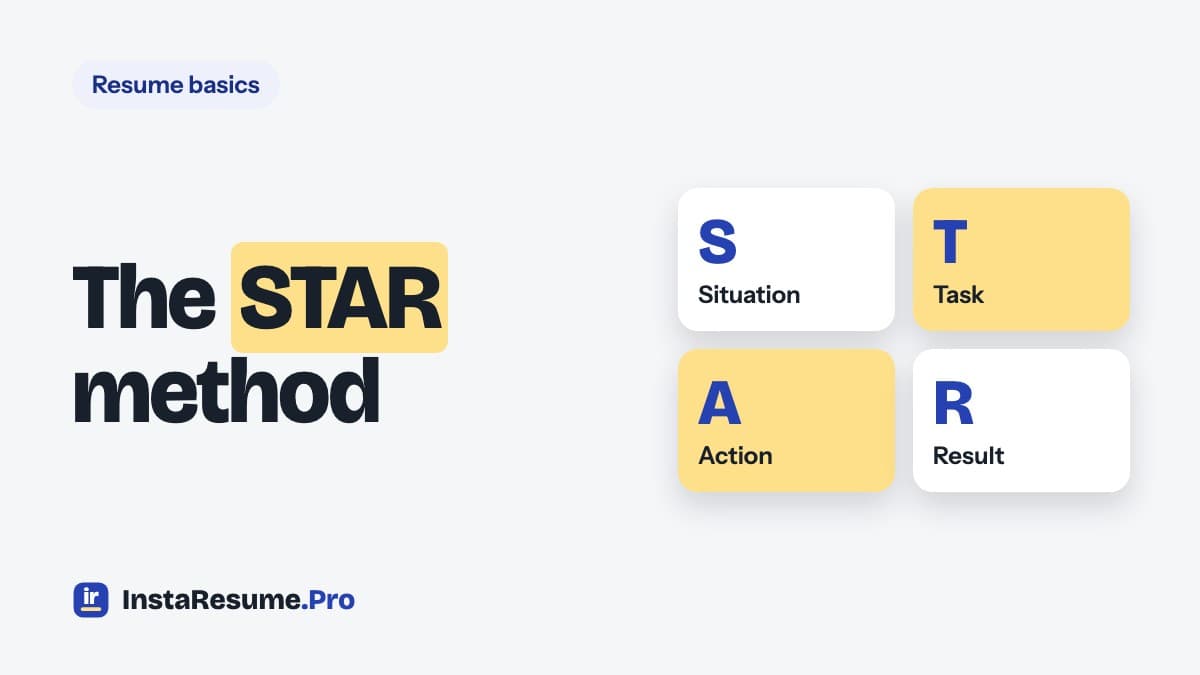
The STAR method is a simple framework for writing resume bullet points and interview answers that show real impact. STAR stands for:
- Situation — the context or challenge
- Task — your specific responsibility
- Action — what you did
- Result — what happened because of it
It started as a way to answer behavioral interview questions ("Tell me about a time when…"). It works just as well on a resume or CV, because it turns a list of duties into evidence of what you can do.
Why STAR Works on a Resume
A bullet like "Provided patient care" or "Did service calls" tells a recruiter nothing they didn't already assume from your job title. A STAR bullet shows what you faced, what you did about it, and how it turned out.
Hiring managers already know what the job involves. What they want to know is how well you did it.
STAR Method Examples
Example 1: Registered Nurse
Without STAR (weak):
Responsible for patient safety on the unit.With STAR (strong):
Unit had a run of patient falls on night shift (S); asked to lead the fall-prevention effort (T); set up hourly rounding and bed-alarm checks with the CNAs (A), and the unit went four months without a fall (R).Example 2: HVAC Technician
Without STAR:
Performed maintenance on commercial HVAC systems.With STAR:
Took over a 12-building service contract with frequent emergency calls (S/T); built a seasonal preventive-maintenance schedule for every rooftop unit (A), cutting emergency calls enough that the client renewed the contract for three years (R).Example 3: CDL Truck Driver
Without STAR:
Drove regional routes.With STAR:
Assigned a regional route with tight dock appointments (S/T); planned routes around peak traffic and pre-trip inspections (A), finishing the year with zero preventable accidents and on-time deliveries for every major account (R).Example 4: Project Manager
Without STAR:
Led a major infrastructure project.With STAR:
Inherited an overdue $1.2M infrastructure migration with 3 months to the deadline (S/T); restructured the plan and negotiated vendor extensions (A), finishing on time and $80K under budget (R).The numbers in these examples are illustrations. On your resume, use only figures you can back up in an interview.
How to Apply STAR to Your Own Resume
- List your best moments from each job: times you solved a problem, handled something difficult, improved how things worked, or were trusted with more responsibility.
- For each one, ask: What was going on? What was I asked to do? What did I actually do? What happened?
- Add specifics where you have them: patient load, unit or job size, equipment, time saved, money saved, safety record, or feedback you received. If you don't have a number, a specific detail beats a made-up one.
- Compress it into one bullet: one strong sentence, two at most. On a resume, the Situation and Task are often a few words; the Action and Result do the heavy lifting.
The shortcut formula
[Action verb] + [what you did] + [context] + [result]Example: "Trained 6 new graduate nurses on telemetry monitoring and Epic charting, and all six completed orientation on schedule."
For stronger opening words, see our list of resume action verbs.
STAR for Interviews
The same framework works when you're asked behavioral questions, which are common in healthcare and skilled-trades interviews:
- "Tell me about a time you dealt with a difficult patient or family member."
- "Describe a time you noticed a safety problem on a job site."
- "Give me an example of when you had to prioritize several urgent tasks at once."
Answer each one as a 1–2 minute story that follows S → T → A → R. End on the result, and if it fits, add what you learned.
Example answer (nurse): "A patient's daughter was upset that her mother's pain wasn't controlled (S). As the primary nurse, I needed to address it and keep the family informed (T). I reassessed the patient, called the physician for a medication adjustment, and set a time to check back with the daughter every hour that evening (A). The patient's pain came down, and the daughter thanked the charge nurse before discharge (R)."
Turn Your Experience Into STAR Bullets Faster
If you struggle to put your achievements into words, InstaResume.Pro can help. Start a new resume, upload your existing resume, and paste the job description: the AI rewrites your experience into specific, achievement-focused bullets aimed at that job, using only what you've given it. In the editor, the bullet helper asks you for the real details and numbers, then rewrites the bullet with your answers.
For the rest of the process, see how to write a resume step by step.
InstaResume.Pro Team
Contributing writer at InstaResume.Pro, helping job seekers create compelling resumes and advance their careers.