What Are the 3 Most Common Resume Styles? (With Examples)
The 3 most common resume styles are chronological, functional, and combination (hybrid). Here's which one to use for your situation, with examples for nurses, career changers, and more.
InstaResume.Pro TeamMay 2, 20265 min read
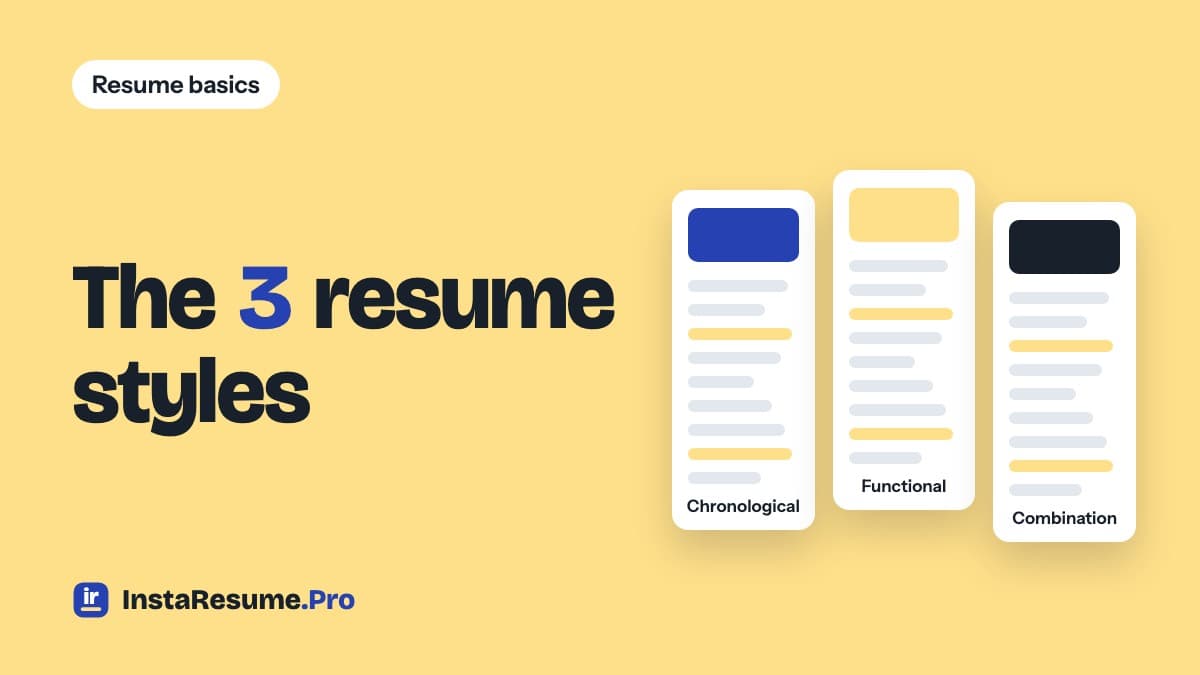
The three most common resume (or CV) styles are:
- Chronological: your experience listed newest to oldest
- Functional: organized by skills instead of a timeline
- Combination (hybrid): skills and highlights first, then your work history
The style you choose affects how quickly a recruiter can understand your story, so it's worth getting right.
1. Chronological Resume
The most widely used format, and the one most recruiters expect.
Structure
- Contact details and professional summary
- Licenses & certifications (if your job requires them)
- Work experience, most recent first
- Education
- Skills
Best for
- People with steady experience in the same field
- Anyone without long, unexplained employment gaps
- Most nursing, allied health, skilled trades, and professional roles
Why it works
Recruiters and applicant tracking systems (ATS) both expect it. It makes it easy to trace your progression and see the scope of each job.
Sample experience section
Registered Nurse, Progressive Care Unit | St. Mary's Medical Center | Dallas, TX | Jan 2022 – Present
• Care for 4–5 telemetry and post-procedure patients per shift on a 30-bed unit
• Serve as relief charge nurse 1–2 shifts a week; precept new graduate nurses
Registered Nurse, Medical-Surgical Unit | Baylor Community Hospital | Dallas, TX | Jun 2019 – Dec 2021
• Managed care for 5–6 med-surg patients per shift, documenting in Epic
• Joined the unit fall-prevention committee and led hourly rounding on nights
2. Functional Resume
A skills-first format that groups your abilities into categories instead of following a timeline.
Structure
- Contact details and summary
- Skill categories (for example: Patient Care, Equipment, Leadership)
- Work history, brief: just titles, employers, and dates
- Education
Best for
- Career changers moving into a new field
- People with long employment gaps
- People re-entering the workforce after a break
Why it can backfire
Many recruiters distrust functional resumes because they hide the timeline. And because your skills aren't tied to specific jobs, an ATS may not connect them to any of your experience. Use this format only if a chronological resume would expose a problem you can't explain another way.
3. Combination (Hybrid) Resume
The best of both: it leads with your strongest skills and achievements, then backs them up with a chronological work history.
Structure
- Contact details and professional summary
- Core skills or highlights (6–8 items)
- Work experience in chronological order, with achievement bullets
- Education, licenses, and certifications
Best for
- Career changers with skills that carry over, such as a military medic moving into civilian EMT or nursing work, or a maintenance tech moving into HVAC
- Experienced people with broad skills
- Anyone targeting a specific role where they want to lead with expertise
Why it works
It shows your value right away in the highlights, then proves it with the work history. Recruiters can see what you can do and where you've done it.
Sample highlights section (career changer)
Core Skills
• Patient assessment and vital signs (6 years as Army combat medic)
• Emergency response, triage, and trauma care
• EMT-Basic certified (National Registry), BLS certified
Which Resume Style Should You Choose?
| Situation | Best format |
|---|---|
| Steady experience in the same field | Chronological |
| Changing careers with skills that carry over | Combination |
| Returning to work after a gap | Combination |
| New graduate or apprentice | Chronological (1 page) |
| Long, unexplained gaps | Functional (last resort) |
Default recommendation: chronological. It's what recruiters expect and what ATS software parses most reliably.
Formatting Tips for Any Style
- Use one column for online applications. Two-column designs look good to people but can confuse ATS software.
- Use standard headings: Summary, Experience, Education, Skills, and Licenses & Certifications.
- Use a clean font (Calibri, Arial, or Helvetica) at 10.5–12pt, with margins of 0.5 to 1 inch.
- Keep it to 1–2 pages for most jobs. See how many pages a resume should be.
For a full walkthrough, see how to write a resume step by step.
Frequently Asked Questions
Q: Is there one best resume format for everyone?
A: No, but reverse-chronological is the right choice for most people, including most nurses, techs, and tradespeople.
Q: Can I use a two-column resume?
A: For a printed copy you hand to someone, yes. For online applications, a single column is safer, because many ATS read across columns and scramble the content.
Q: How do I handle employment gaps?
A: In a chronological or combination resume, a short line usually covers it: "Family caregiver, 2023–2024" or "Completed HVAC certificate program, 2024." You don't need to switch to a functional format.
Build Your Resume in the Right Format
InstaResume.Pro builds a reverse-chronological resume with a professional summary and skills section, which is the layout most recruiters expect, aimed at the job description you paste in.
InstaResume.Pro Team
Contributing writer at InstaResume.Pro, helping job seekers create compelling resumes and advance their careers.